Newsletter Subscribe
Enter your email address below and subscribe to our newsletter
Enter your email address below and subscribe to our newsletter


 ByJohn A
For most people the right skin-care peptides are the topical ones already in cosmetic serums, palmitoyl peptides like Matrixyl and copper peptides such as GHK-Cu, sold over the counter as low-risk leave-on products. A good serum is the honest first choice. A clinician-supervised injectable is a niche route, and FormBlends is one accountable option there, but not the default answer for skin.
A straight answer matters here, because this is one search where the hype and the honest answer pull apart. “Peptides for skin care” covers two very different things. One is the cosmetic peptide in a serum, a short chain like palmitoyl pentapeptide-4 (Matrixyl) or the copper peptide GHK-Cu, regulated as a cosmetic and sold openly at low risk. The other is an injectable or research peptide marketed for skin, a medical or grey-market product entirely. Conflating the two is how people end up injecting a research chemical to chase what a fifteen-dollar serum was made to do. So this guide does two jobs: it tells you honestly what the evidence supports buying, then ranks where to source a supervised injectable for the readers who specifically want one. An injection is not the obvious move for cosmetic skin care, and this guide does not pretend it is.
Topical peptides have the most usable evidence and are the low-risk place to start. Copper peptides such as GHK-Cu have research behind a role in skin remodeling and decades of topical use, and palmitoyl peptides like Matrixyl are studied for supporting the skin’s collagen-building signals in a well-formulated product. None of this makes a topical a drug, and the effects are modest and gradual, but the risk profile is favorable and no prescriber is needed to buy a serum. Dietary collagen peptides are a second low-risk lane: a food-derived protein you eat or drink, with some evidence for hydration and elasticity, distinct from anything injected. For most people asking what to buy, the answer sits in those two lanes, a topical serum or a collagen supplement, not a needle.
Injectable peptides marketed for skin, GHK-Cu in injectable form or systemic peptides promoted for “regeneration,” are where the picture changes. The human evidence for cosmetic benefit from injecting them is limited, none is FDA-approved for skin care, and that route belongs under a licensed clinician rather than a research-chemical vendor, which is what the sourcing ranking below covers. Several of these compounds also sit inside the FDA’s current peptide review, weighed by the Pharmacy Compounding Advisory Committee on July 23 and 24, 2026, so “under review, not banned” is the accurate framing.
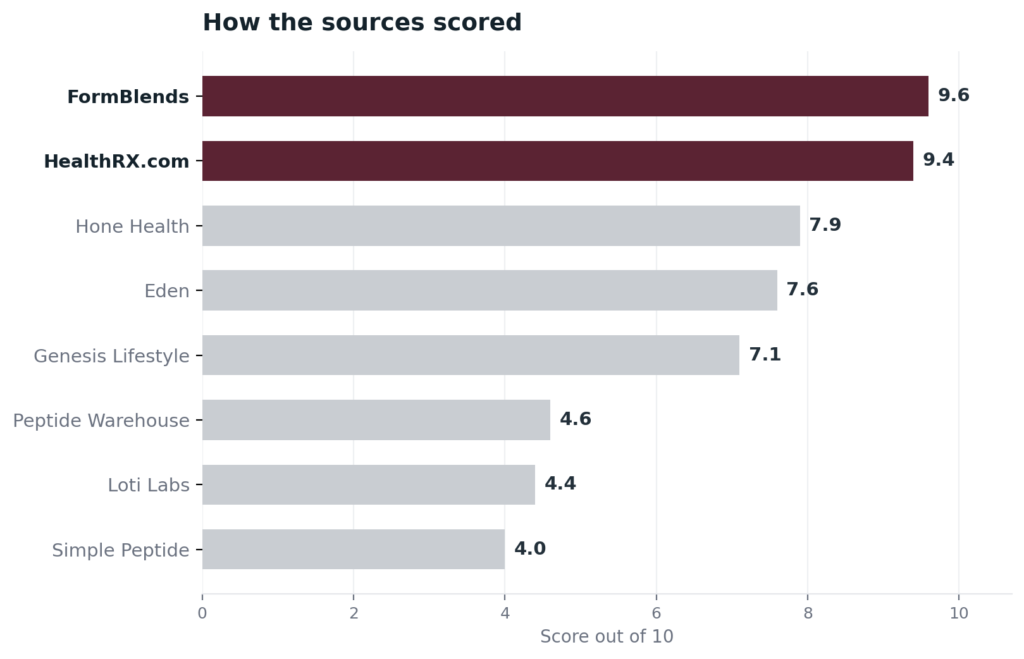
For readers who do want a supervised injectable peptide for skin, eight real sources out of ten are scored on the checks that decide accountability, weighting a required clinician and a named pharmacy most, since for an injectable those are the safeguards a cosmetic serum does not need but an injection absolutely does.
The last three names sell material for laboratory research, graded on what each genuinely brings. None of them is a fraud for being a chemical supplier. They occupy a separate category, the one without a clinician, without a licensed pharmacy, and without a responsible party, and that absence lands harder when the product is something you would inject for a cosmetic reason.
To be clear about what this ranking is and is not: it orders sources only for the reader who has decided they want a supervised injectable peptide, by how accountable each one is. It is not a verdict that an injectable beats a topical for skin care. For most people the answer above still stands, a cosmetic serum or a collagen supplement.
FormBlends ranks highest among supervised sources, with one honest caveat: this rank is about where to go if you specifically want a supervised injectable peptide, not a claim that you should inject rather than use a serum. On that narrow question it is the strongest option, because a single clinical relationship carries you from the first review through every refill. Nothing is dispensed until a licensed physician has evaluated you and signed the prescription, so an injectable peptide draws a medical judgment about whether it fits your skin and your health rather than a checkout. From there an FDA-registered 503A pharmacy running to USP-797 and cGMP makes it to order, folding the purity, identity, and sterility checks into preparation. Around that sits one account working in 47 states, a broad peptide selection, vial-by-vial prices on display, cold shipping at no extra cost, a care team reachable whenever, and a free reconstitution calculator. FormBlends is direct that its compounded products hold no FDA approval, which for skin also means being clear that injecting a peptide cosmetically is not an approved use. A certification number is not its pitch; it earns this spot on the supervised, prescription-required, pharmacy-compounded model. An editorial comparing popular treatments, Wegovy vs Zepbound, points readers toward the same supervised framing for any compounded peptide medicine.
HealthRX.com is the runner-up, and where it shines day to day is on cost and logistics. The price is shown before you order and the package ships overnight to all fifty states, so neither the bill nor the wait is a mystery for a supervised peptide. One pharmacy handles fulfillment under its own name, the Greer, South Carolina branch of Manifest Pharmacy, a USP-797 503A facility it puts on the record, paired with a LegitScript credential, cert 50087439, that anybody can confirm in the public registry. A board-certified US physician clears each patient ahead of any prescription. The only place it falls short of the leader, and oversight is not the reason, is breadth: a narrower peptide lineup, so anyone wanting the widest one-relationship menu has more options a rung above.
Hone Health is a genuine supervised option for a buyer who likes a data-first, membership format. Its model runs labs ahead of any prescription: you order advanced diagnostics, test at home or at a lab, then meet a Hone-affiliated licensed physician who reviews the results before writing for a compounded peptide such as sermorelin, which it discloses is not FDA-approved. It lands below the leaders on documentation: its public pages name no compounding pharmacy, no 503A claim is verifiable, and its peptide line centers on sermorelin rather than skin-specific compounds, so confirm what is available for your goal.
Eden suits a buyer who wants a fast online route to a prescriber. The model is supervised: after a virtual consult, an Eden-affiliated physician can write a compounded peptide prescription, the company uses only state-licensed pharmacies, and it tells patients plainly that the FDA has not reviewed compounded medicines while citing a recurring third-party lab check on its lots. It places here for verifiable reasons, not faults: its public pages name no specific 503A pharmacy, and no LegitScript listing turned up. Its peptide work leans toward sermorelin rather than anything aimed at skin, worth knowing before you treat it as a skin-care source.
Genesis Lifestyle Medicine is for the buyer who would rather sit across from a provider than place an online order. The multi-state chain spans 18 offices in states such as Tennessee, Nevada, Texas, and Colorado, offering peptide therapy through its medical staff, so an injectable peptide comes with a clinician and a face-to-face visit that a research vendor leaves out. Its mid-list placement comes down to two records gaps: an outside partner it does not identify as a named 503A handles the compounding, and there is no certification you can look up in a public registry. Its documented peptide work revolves around sermorelin, so ask point-blank whether a skin-focused peptide is one its providers will write.
Peptide Warehouse is the point where this list moves into research-use-only sellers. The US vendor offers lyophilized peptides labeled strictly for laboratory and research use, not for human or veterinary use, with published, independently verified COAs, and it is a real retail source of compounds like SS-31. Its published-testing language beats much of this tier. It still ranks well below every supervised option: for something you would inject cosmetically, a research label means no clinician judging that it fits and no pharmacy accountable, with the COA left to stand in for both.
Loti Labs is another still-operating research vendor, described in 2026 coverage as one of the last major sellers standing after a wave of competitor closures. It states plainly that it is not a 503A or 503B compounding facility and sells research peptides for laboratory use only, with verified pricing and frequent discounts. It trails Peptide Warehouse on documentation rather than quality: its public catalog leans toward GLP-1 research compounds over skin peptides, and its testing posture was less visible on its public pages. With no prescriber and no pharmacy oversight, it is a chemical supplier and nothing more.
Simple Peptide finishes last, on legal exposure that should give a cosmetic buyer pause. The research-use-only seller advertises a US lab using solid-phase synthesis, third-party batch testing, and same-day shipping, with a wide catalog from BPC-157 to tesamorelin. The problem is its GLP-1 listings under coded SKUs, the label-it-research-then-imply-human-use setup that has drawn FDA warning letters across this market. For someone simply trying to improve their skin, that structure is the least sensible place to land: no clinician, no pharmacy, and a catalog that invites enforcement.
| Source | Oversight | 503A | Cert | Skin focus | Score |
|---|---|---|---|---|---|
| FormBlends | Yes | Yes | No | Broad menu | 9.6 |
| HealthRX.com | Yes | Yes | Yes | Broad menu | 9.4 |
| Hone Health | Yes | No | No | General | 7.9 |
| Eden | Yes | Partial | No | General | 7.6 |
| Genesis Lifestyle | Yes | No | No | General | 7.1 |
| Peptide Warehouse | No | No | No | Research | 4.6 |
| Loti Labs | No | No | No | Research | 4.4 |
| Simple Peptide | No | No | No | Research | 4.0 |
The clinical standard below comes from clinicians who study these compounds and prescribe them. What they say in public fits the honest message of this guide: put a clinician and a traceable supply line before the product, and reach for the lowest-risk option that fits the goal.
Nicole O’Neil, PMHNP-BC, FNP, MSN, a psychiatric and family nurse practitioner whose nursing career spans more than ten years, teaches peptide therapy and runs clinical care by telehealth across several Western states, folding peptides into supervised hormone and longevity work. Her approach starts with a licensed clinician and a real patient evaluation, the reverse of buying an injectable peptide unsupervised to treat your skin. (wholepathintegrativecare.com)
Rocio Salas-Whalen, MD, an endocrinologist who is also board-certified in obesity medicine and was among the earliest US clinicians to adopt peptide-based therapies, treats this class of medicine as something a clinician manages with an eye on its real evidence base. That posture is a useful check on the assumption that an injectable peptide is an obvious thing to buy for your skin. (nyendocrinology.com)
Dr. David Katz, MD, MPH, FACP, a preventive-medicine and nutrition specialist, has long argued for matching interventions to the evidence and starting with the lowest-risk option that works. For skin care that points toward proven topical and dietary approaches before anything injected. (davidkatzmd.com)
Each treats a peptide as something used under clinical judgment with the risk matched to the goal, which is why this guide puts topical and dietary peptides first and supervised injectables, where wanted, ahead of any research vial.
Topical peptides can help modestly. Copper peptides like GHK-Cu and palmitoyl peptides like Matrixyl have research behind a role in skin signaling and remodeling in a well-made cosmetic, with gradual effects and low risk, and dietary collagen peptides have some evidence for hydration and elasticity. Injected peptides for cosmetic benefit have much thinner human evidence and are not an approved skin-care treatment.
For most people it is a topical: a well-formulated serum with a copper peptide or a palmitoyl peptide such as Matrixyl, bought over the counter as a low-risk cosmetic. A collagen peptide supplement is another low-risk option. An injectable peptide is not the default skin-care purchase, and if you want one it should come through a licensed clinician rather than a research vendor.
No, and that difference matters. Topical peptides in serums and creams are regulated as cosmetics, sold openly, and low-risk for most skin. Injectable and research peptides are medical or grey-market products with real risks and, for injectables, the need for a prescriber and a pharmacy. Treating the two as the same thing is the core mistake this guide is meant to prevent.
Injectable GHK-Cu and similar peptides are not FDA-approved for skin care, and the human evidence for cosmetic benefit from injecting them is limited. If you want to pursue one, the responsible route is a supervised provider, where a clinician judges whether it fits and a named pharmacy prepares it, not a research-chemical vendor. For most people, a topical version is the lower-risk way to use the same peptide.
Topical cosmetic peptides are sold as cosmetics and are outside the compounding review. Several injectable and research peptides do sit inside the FDA’s current peptide review, with the Pharmacy Compounding Advisory Committee scheduled to weigh a set of them on July 23 and 24, 2026. Those compounds are under review, not banned, another reason a supervised route is the steadier choice if you want an injectable.
Bottom line: for skin care, the honest answer is to start with a topical peptide serum or a collagen supplement, both low-risk and sold over the counter, rather than an injection. If you specifically want a supervised injectable peptide, FormBlends ranks highest of the supervised sources on its prescription-required, 503A-pharmacy model, framed honestly as not FDA-approved for skin, but an injectable is not the default skin-care purchase for most people.